.svg)
The 5-Step Burnout Recovery Loop
Two of the biggest burnout questions people ask are:
- Am I burned out?
- How do I recover?
The simple truth is that there is no simple answer that works for everyone. Your burnout story is unique to you, shaped by your specific circumstances and experiences.
That said, plenty of smart people have created tools to help figure out if you're burned out. There's the 5 stages model, Freudenberger's 12 stages, the Maslach Burnout Inventory, and the Burnout Assessment Tool (which you can take for free here).
But when it comes to recovery? That's where things get tricky. Google "burnout recovery" and you'll find random tips or more assessment tools—but no actual roadmap for getting better.
Why? Because recovery isn't linear. You don't just follow five tips and suddenly feel better. It's more like a dance—one step forward, one back, two forward, one back. Sometimes you'll take two steps back after moving forward. It's messy, zigzagging progress that eventually builds momentum until the burnout fog lifts.
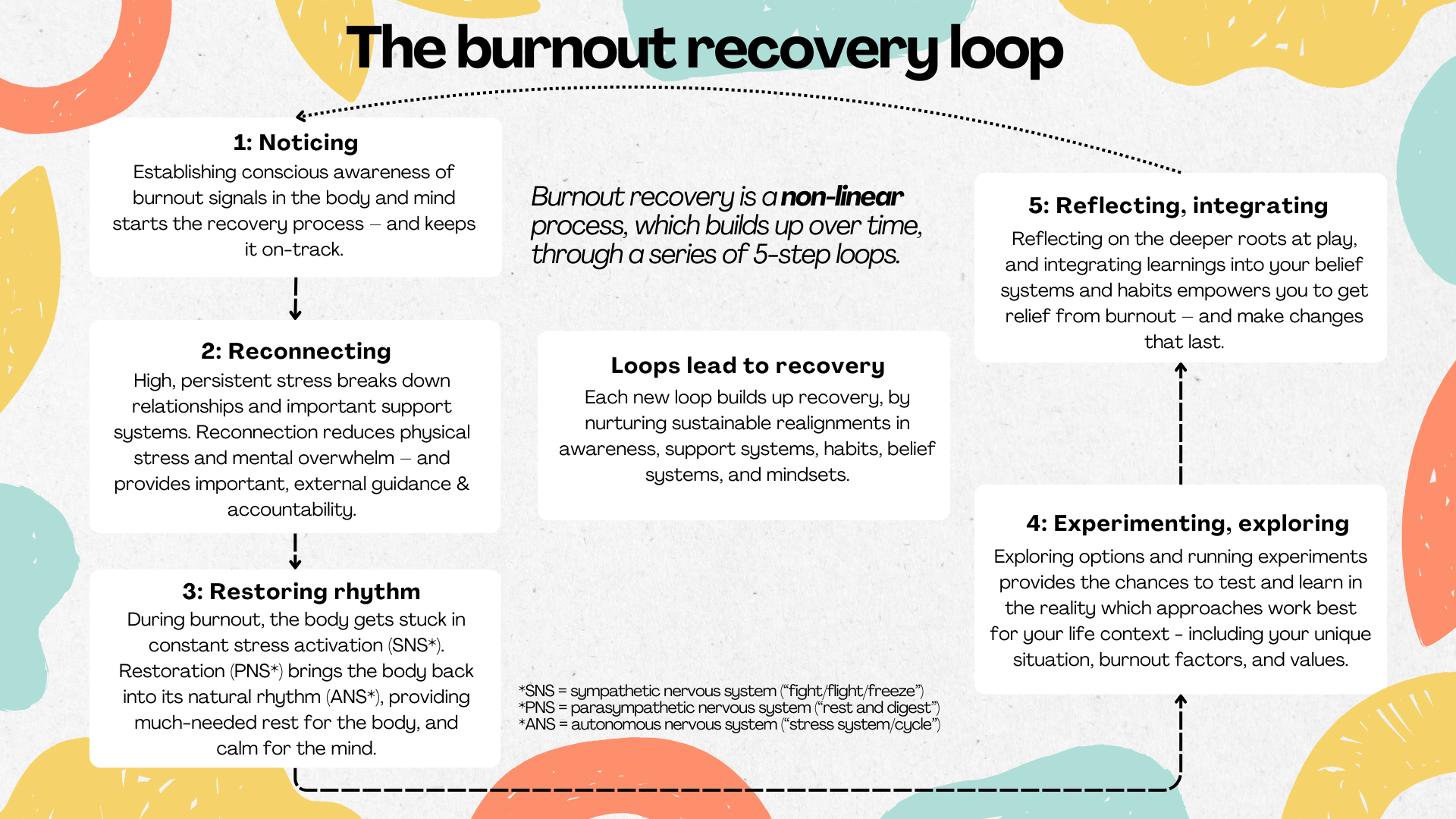
That's why we created something new: The 5-Step Loop for Burnout Recovery. It's specifically designed for people who know they're burned out and want a realistic framework for recovery—one that acknowledges the back-and-forth nature of getting better.
Here’s how it breaks down:
1: Noticing
Establishing conscious awareness of burnout signals in the body and mind starts the recovery process – and keeps it on-track.
2: Reconnecting
High, persistent stress breaks down relationships and important support systems. Reconnection reduces physical stress and mental overwhelm – and provides important, external guidance & accountability.
3: Restoring
During burnout, the body gets stuck in constant stress activation (sympathetic nervous system or “fight/flight/freeze” mode). Restoration (parasympathetic nervous system or “rest and digest” mode) brings the body back into its natural rhythm (autonomous nervous system, or the “stress system/cycle”), providing much-needed rest for the body, and calm for the mind.
4: Experimenting, exploring
Exploring options and running experiments provides the chances to test and learn in the reality which approaches work best for your life context - including your unique situation, burnout factors, and values.
5: Reflecting, integrating
Reflecting on the deeper roots at play, and integrating learnings into your belief systems and habits empowers you to get relief from burnout – and make changes that last.
Loops lead to recovery
Each new loop builds up recovery, by nurturing sustainable realignments in awareness, support systems, habits, belief systems, and mindsets.
Loops, not stages
Throughout the recovery journey, earlier steps are looped through again, and some steps may even be skipped as these loops happen.